

SEO in 2026: Why your content still isn’t ranking — and what I’m doing differently
A real account of what stopped working, what changed my thinking, and the simple strategy I now follow — with zero shortcuts.

The honest start
For a long time, I thought SEO was a simple equation: Keywords + Content + Patience = Traffic. That’s what every tutorial said. So I followed the rules, found my keywords, wrote the blogs, and waited.
Understanding the intricacies of SEO in 2026 is essential for anyone looking to improve their online presence.
The result? Complete silence. No traffic. No rankings. No growth.
That silence forced me to ask a harder question — not “how do I rank?” but “am I actually writing anything worth reading?” The answer, honestly, was no.
One must adapt their strategies to the evolving trends of SEO in 2026.
Keeping up with SEO in 2026 is not just beneficial; it’s a necessity for survival in the digital landscape.
What SEO actually looks like in 2026
Understanding the Future: SEO in 2026
Search has fundamentally changed. A user searching today may never visit a single website — they get an AI overview, a YouTube short, a featured snippet, or a Reddit thread. “Just ranking” is no longer the finish line.
Google’s algorithm has shifted from matching keywords to understanding intent, making SEO in 2026 more complex. If your content doesn’t genuinely answer the question behind the search, it won’t place.
The hard truth: if you’ve seen zero growth for months, it’s not a time problem. It’s an approach problem.
Focusing on SEO in 2026 means addressing the specific needs of your audience.
Engaging with the audience about SEO in 2026 requires understanding their pain points deeply.
Accessibility and clarity are key elements in writing about SEO in 2026.
The 5 shifts I made (and why they work)
1. I stopped chasing keywords — I started chasing pain points
Utilizing various platforms to share insights on SEO in 2026 enhances overall engagement.
High-volume keywords are often too broad to convert. Someone searching “SEO tips” could be anyone. But someone searching “why is my SEO not working even after posting every day” — that person has a specific problem and is ready to engage.
I still research keywords. But now I use them to find the frustration hiding behind the search, then I write to that frustration directly.
2. I write the way I actually speak
Broadening exposure about SEO in 2026 can lead to unexpected growth opportunities.
I used to write to sound professional. Now I write to be understood. Short sentences. Simple words. Enough white space that someone reading on a phone can actually follow along. Readability is a ranking signal — if people bounce immediately, search engines notice.
3. I use the content multiplier method
Understanding the evolution of SEO in 2026 helps in creating more targeted content.
One blog post is not one piece of content — it’s a source of ten. Every article I write now gets repurposed into a LinkedIn post, an Instagram caption, a short video script, and a newsletter idea. Consistency stops feeling impossible when you’re not starting from zero every time.
4. I lead with experience, not just advice
Google’s EEAT framework — Experience, Expertise, Authoritativeness, Trust — now actively rewards content written by people who have actually done the thing. Saying “here’s how to do it” isn’t enough anymore. Saying “here’s what happened when I tried it, including what failed” builds a trust layer that AI-generated content simply cannot replicate.
5. I don’t depend on search alone
People discover content through Instagram, YouTube, newsletters, and word of mouth — not just Google. I now try to show up in at least two of those channels consistently. Search traffic is a reward for consistency everywhere, not a starting point.
The only SEO rule that hasn’t changed
Search engines have always tried to surface the most useful result for the person searching. The algorithms have just gotten dramatically better at figuring out what “useful” actually means.
So the principle remains the same as it was in 2010: write for people first. Everything else — keywords, backlinks, technical SEO — works as amplification, not as a foundation.
As I navigate through SEO in 2026, I’m constantly learning and adapting.
The evolving landscape of SEO in 2026 requires continual adaptation to strategies.
To thrive, one must embrace the changes in SEO in 2026 and adjust accordingly.
If you’re just starting out, begin here:
- Pick one specific topic in your niche
- Write from your actual experience with it
- Share it wherever your audience actually spends time
- Repeat consistently for at least 90 days
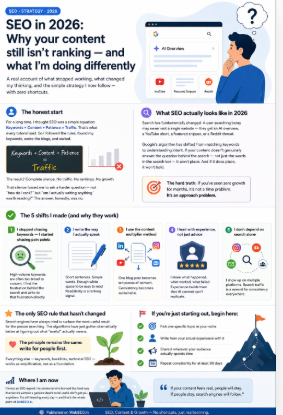
SEO in 2026: Why Your Content Still Isn’t Ranking
Where I am now
I’m not an SEO expert. I’m someone who learned the hard way that tactics without a genuine desire to be useful don’t get you anywhere. I’m still learning every day — and that’s the whole point of WebSEO.in.
No shortcuts. No black-hat tricks. Just honest documentation of what works — and what doesn’t — in an AI-driven search landscape.
If your content feels real, people will stay. If people stay, search engines will follow.
Published on WebSEO.in · SEO, Content & Growth — No shortcuts, just real learning.